Yalda Afsah
PAN
Opening: 29 Jan 2026, 6–9 pm
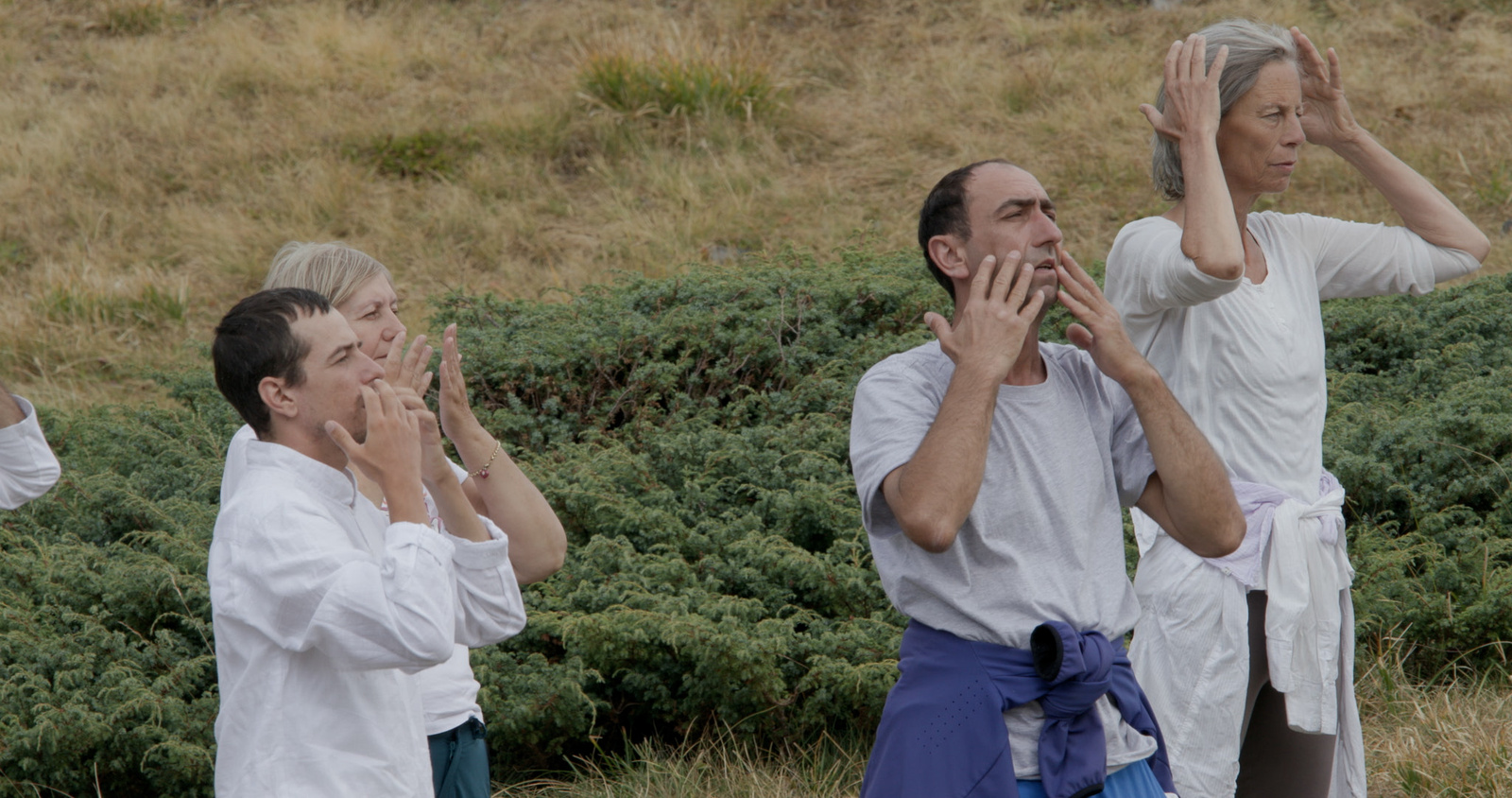
Yalda Afsah, PAN, 2026. Film still. Courtesy the artist.
pan
[prefix]: All, completely, relating to the cosmic; including or relating to all the places or people in a particular group.
[verb]: To move (a video camera) slowly from one side to another or up and down.
[noun]: The Greek deity of the wild, shepherds, flocks, rustic music, and nature.
Yalda Afsah’s film PAN (2026) begins in the dark. A small figure moves through the night, soon joined by others. Flickering lights meet along an ascending path. Up on the hill, people look to the sky, quietly waiting. A raw red sun signals dawn. This mesmerizing sequence opens Afsah’s exploration of the Bulgarian spiritual practice of Paneurhythmy, marking the second opus in the German-Iranian artist and filmmaker’s new series of works attending to folk traditions and their ritualistic choreography. Following her charged portrait of the Jarramplas festival in the Spanish town of Piornal—where crowds hurl turnips at a figure never shown in the film—PAN turns its attention to the spiritual devotion and performative synchronicity of an assembly, with no less ambivalence or suspense.
Each August, around two thousand people from around the world gather in Bulgaria’s Rila Mountains to perform Paneurhythmy—an esoteric practice created in the 1930s by the Bulgarian philosopher and spiritual teacher Peter Deunov, founder of the so-called Universal White Brotherhood. Derived from the Greek, pan-eu-rhythmy—literally the “cosmic supreme rhythm”—is intended to harmonize one’s body, emotions, and thoughts through a combination of physical exercises and spiritual teachings. According to Deunov, the practice promotes a reciprocal exchange between humans and the cosmos, cultivating unity with nature and inner balance. Dressed in white and barefoot, practitioners perform a choreographed circle dance on the highland near the kidney-shaped Babreka Lake to celebrate the “Divine New Year” on the 20th of August. The color white is said to symbolize the purity of the soul and the all-encompassing light of spiritual wholeness.
Upon entering this world, Afsah lets her camera circle around, weave through, and hover above the crowd. The lens pans across bodies and faces—expressions serene, eyes closed—as the dancers sway their arms to the cadence of their singing. The center of the circle remains out of view, where string musicians, never fully revealed, play folk tunes to guide the choreography. Sounds of nature and music blend together with a richly textured audio design, layered seamlessly to heighten the scene’s eerie undertone. Following the ebb and flow of synchronized movements, a rhythm of breath comes to the fore, lending an intimate pulse to the group’s swinging motion. From a bird’s-eye view, individuals dissolve into a single, homogeneous body with a life of its own—the white ring formation flexing and rippling like waves, animated by a shared, pulsating beat. The film ends on a haunting aerial shot that reveals the concentric circles left by the dancers, the earth bearing an uncanny afterimage of human presence and movement.
In the corner rooms, Afsah stages a series of installations that echo the circular pattern of Paneurhythmy. Three additional screens play short scenes on a loop, tracing the sun’s rise and fall to mark the three stages of the ritual. Enlarged photographs of scattered clothing cover the floor, captured during the filming of PAN. They recall the moments when participants changed their clothes before and after the ritual, leaving them in the bushes or on the ground. The artist is as drawn to these in-between moments—of waiting, preparation, and rest—as she is to the ritual itself. The discarded garments, left just outside the circles, inhabit a place both beneath and beyond the performed homogeneity. Quietly, they are a reminder of what is set aside—the different and the incongruent—in the spiritual pursuit of wholeness and harmony with the natural world.
—Nan Xi
Supported by Karin and Uwe Hollweg Foundation.
Curators: Fabian Schöneich with Nan Xi
Production: Franz Hempel with Kirstine Kjeldsen
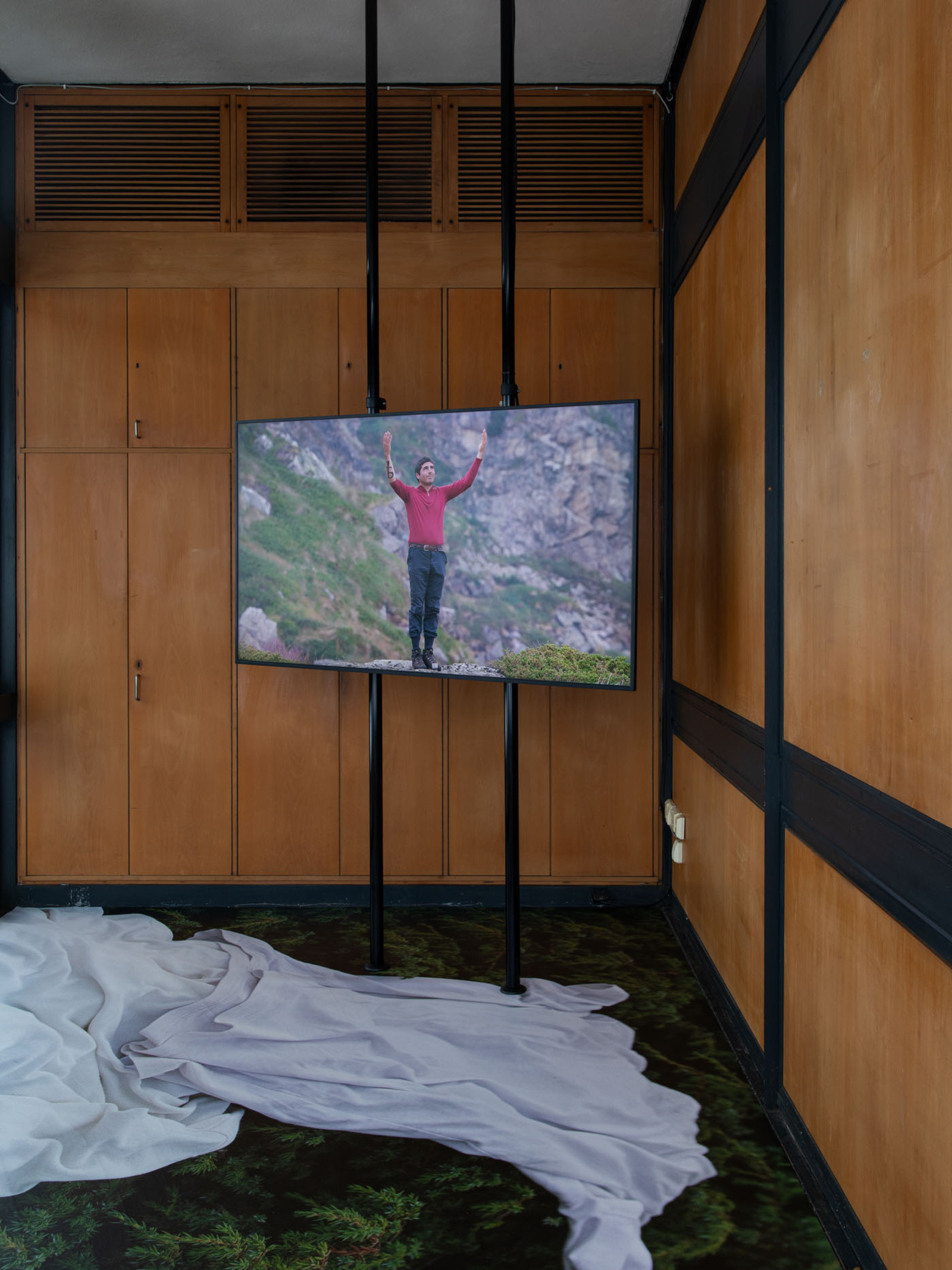
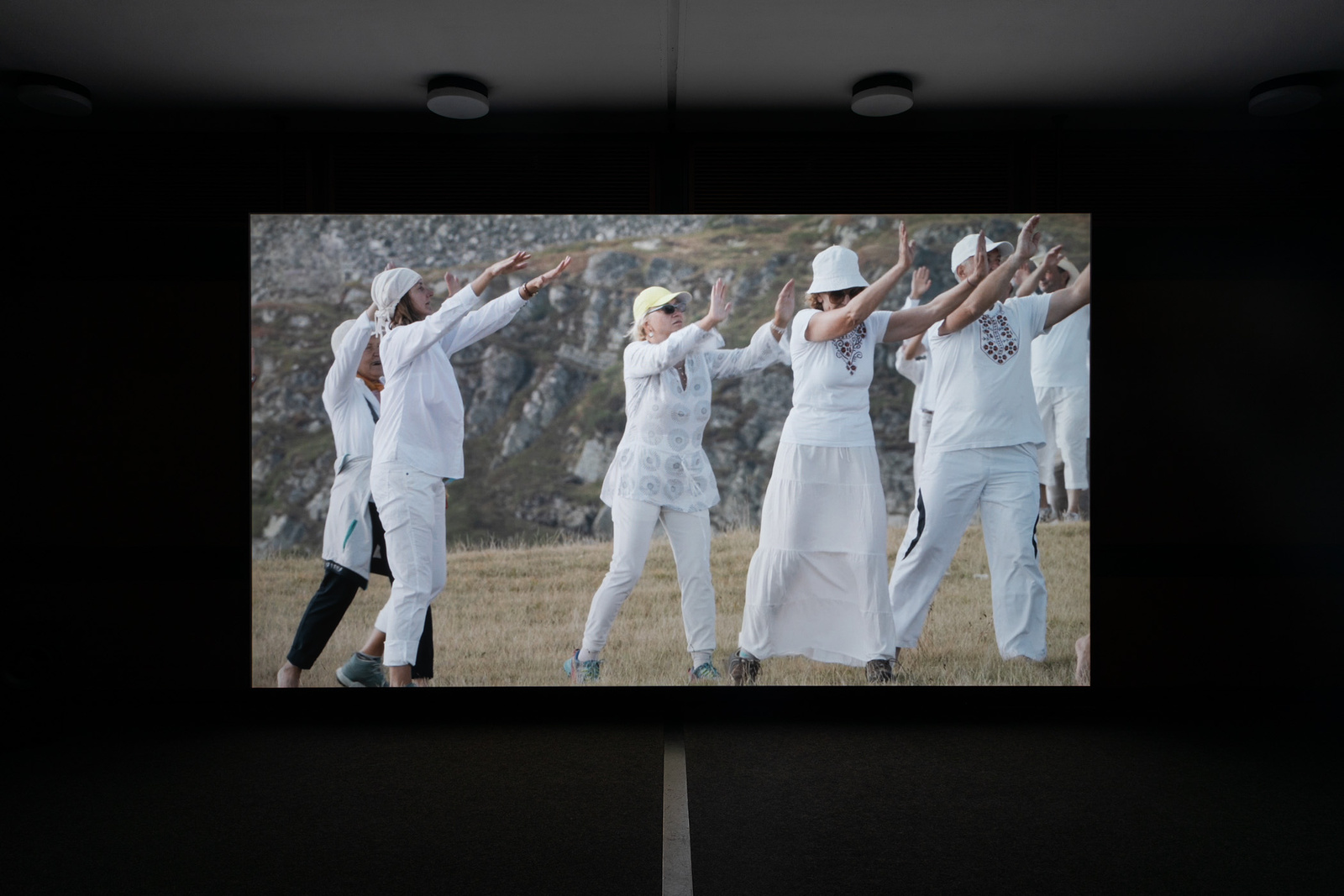
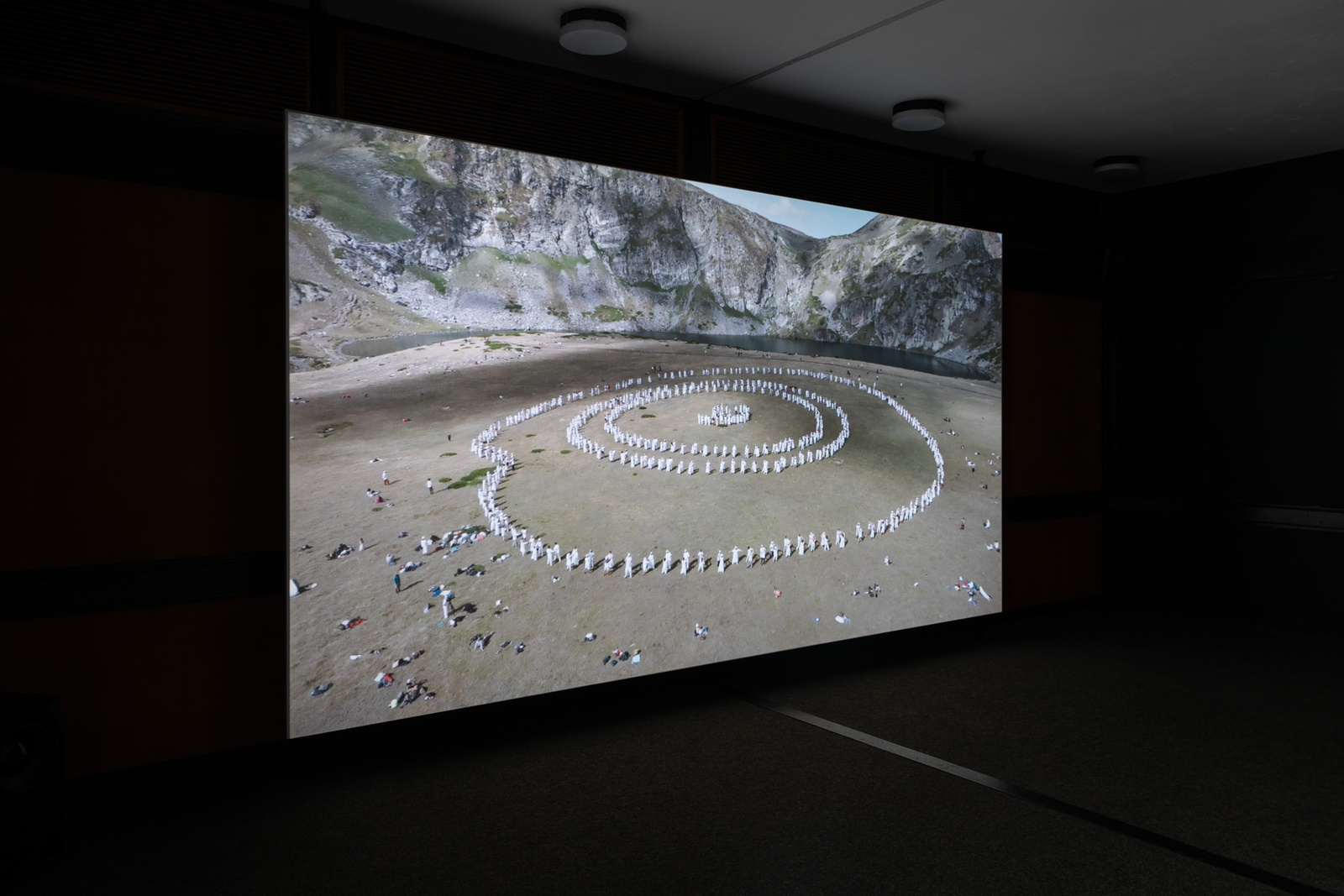
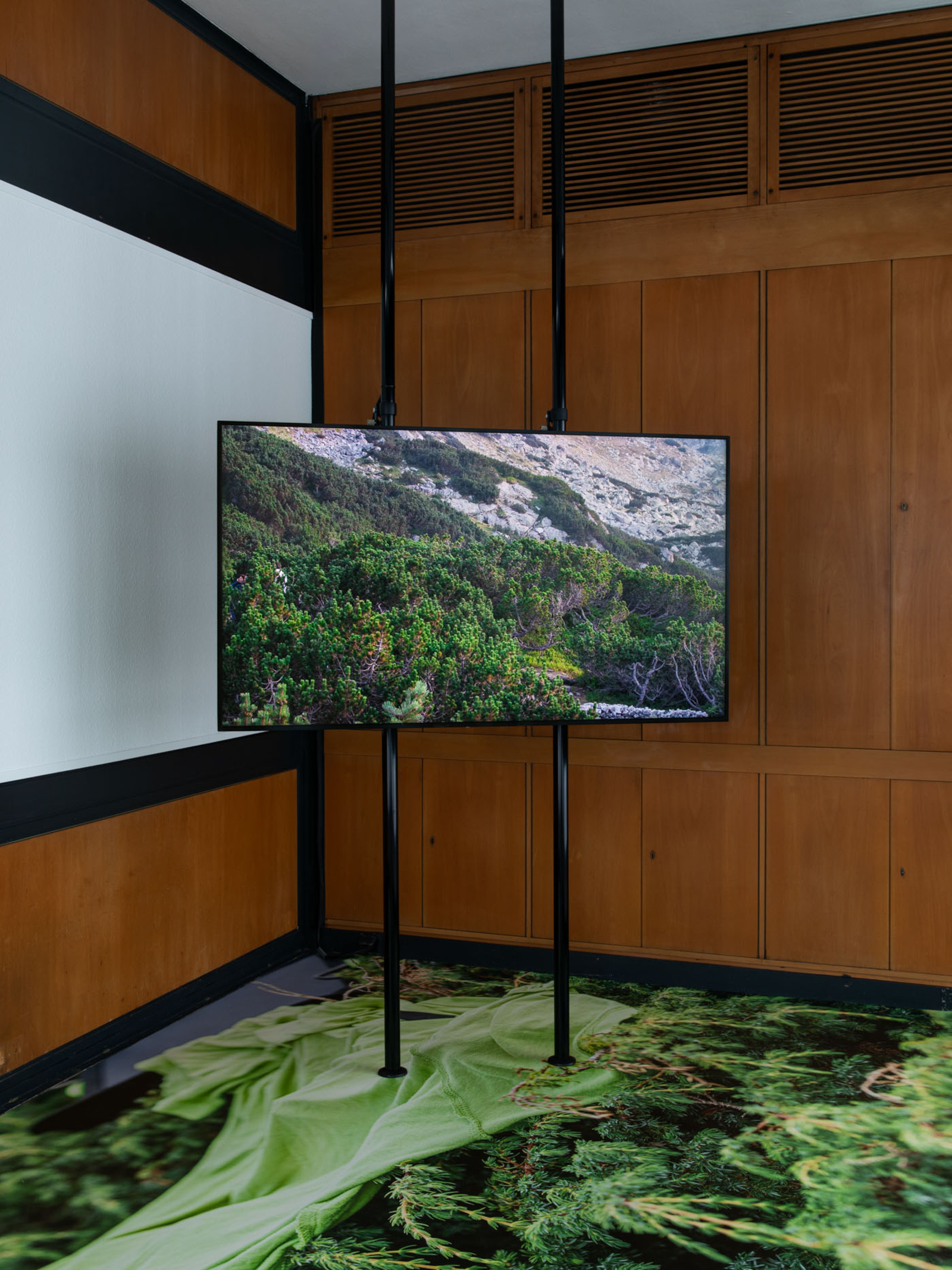
Yalda Afsah, PAN, Exhibition views, CCA Berlin, 2026. Photos: Diana Pfammatter/CCA Berlin
Yalda Afsah (b. 1983, Berlin) is a German-Iranian artist and filmmaker who lives and works in Berlin. Her practice explores the extent to which filmed space is constructed through cinematic techniques. Her works have been shown at various international exhibitions and film festivals, including Manifesta 13, Locarno Film Festival, New York Film Festival, Berlinische Galerie, Institute of Contemporary Arts London and Neuer Berliner Kunstverein. She has had solo exhibitions at JOAN, Los Angeles (2023), Between Bridges, Berlin (2023), HALLE FÜR KUNST Steiermark, Graz (2022) and Kunstverein München (2022). She was awarded the Hans Purmann Prize in 2023 and is currently teaching professor at HFBK, Hamburg.